
When it comes to immigration, I’m not writing from an inherited political position as I come from a family of immigrants myself. My great-grandparents on my mother’s side were Sicilian immigrants who crossed the Atlantic by boat and were processed through Ellis Island. On my father’s side, my grandmother emigrated from Nicaragua to Costa Rica, and later onward to Salt Lake City, Utah. Multiple generations later, the distance between immigration as lived reality and immigration as moral spectacle is obvious to me, which is precisely why I don’t confuse institutional theater involving children with principled civic action.
Entering the United States without immigrating properly is not an accident; it is a choice made by adults. When a student is deported midway through their education, that disruption is not the result of some sudden moral failure by the state, but the delayed consequence of decisions made years earlier by guardians who assumed the risk and proceeded anyway.
Every undocumented family understands, at least implicitly, that their status is provisional and contingent. Access to public schooling does not convert an unlawful entry into a permanent guarantee of residence. Parents chose a path that exposed their children to instability. That does not make the children culpable, but it does make the adults responsible. Converting that parental failure into a moral indictment of enforcement institutions, and then using students as emotional leverage against those institutions, does not correct the original decision.
Staging Student Dissent
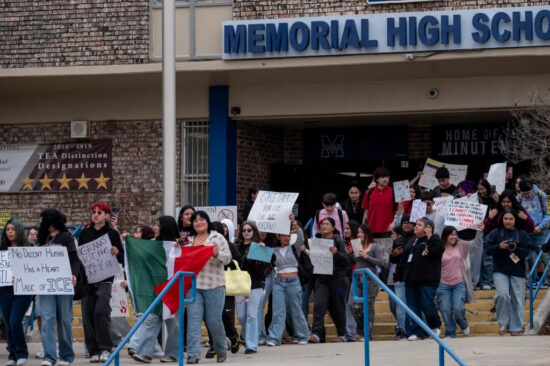
Recent K–12 walkouts illustrate exactly how student protests function as adult-mediated spectacle rather than independent civic judgment. In Texas, the Houston Chronicle documented Fort Bend ISD students leaving class mid-morning to gather on football fields and parking lots, chanting familiar activist slogans such as the classic “no human is illegal on stolen land,” and framing immigration as a moral absolute rather than a policy question. Similar scenes followed across the Houston area, with planned walkouts coordinated via social media and hundreds of students protesting ICE after a single detention case was elevated into a district-wide symbol.
In Utah, middle- and high-school students walking off campus, carrying Mexican flags alongside American ones, and displaying signs reading “ICE is better crushed,” rhetoric that clearly exceeds neutral civic education and reflects adult ideological messaging. In Oregon, Portland high school students marching through city streets during school hours chanting “This is what democracy looks like!” and “Stop ICE Terror Now,” again mirroring standardized activist language. Across these cases, the pattern is consistent: minors leaving compulsory classrooms to repeat movement slogans, framed as brave moral action, while the optics of youthful defiance are leveraged to evoke sympathy, suppress dissent, and launder partisan positions through the perceived innocence of children.
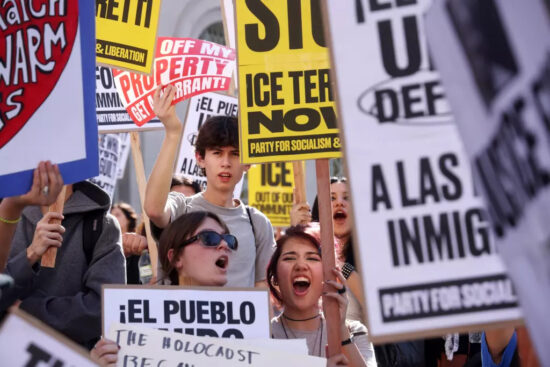
Marxist and quasi-Marxist movements have consistently targeted children and adolescents precisely because they are developmentally primed for moral absolutism, symbolic action, and group identity over institutional analysis. From early Soviet youth leagues to Komsomol, from Mao’s mobilization of students during the Cultural Revolution to the Red Guards, the logic has remained unchanged: bypass adult skepticism by moralizing politics through youth, then weaponize their visibility and perceived innocence to generate pressure and legitimacy.
What we are seeing in contemporary K–12 walkouts is not a spontaneous civic awakening but a softened, domesticated version of the same tactic. The rhetoric is simplified, consequences are abstracted, and participation is framed as virtue rather than understanding. The fact that these demonstrations occur inside taxpayer-funded schools, under the implicit authority of educators.
When compulsory public schools become venues for partisan mobilization, students are no longer being educated, they are being positioned. Their age, visibility, and lack of agency are exploited to manufacture moral urgency, obscure accountability, and pressure the public through emotional blackmail rather than argument. A system that claims to protect minors while repeatedly placing them at the center of ideological conflict is not acting in their interest. It is using them. And that is the ethical failure at the core of these protests, not disagreement over policy, but the quiet normalization of political instrumentalization in spaces where neutrality was once assumed.
References
- Houston Chronicle — “Hundreds of Houston-area students walk out to protest ICE arrests” (January 2026)
- Salt Lake Tribune — “Utah students walk out of class to protest ICE enforcement” (January 30, 2026)
- Oregon Public Broadcasting — “Oregon students join protests against immigration enforcement” (January 30, 2026)