
Using Students as Political Instruments

When it comes to immigration, I’m not writing from an inherited political position as I come from a family of immigrants myself. My great-grandparents on my mother’s side were Sicilian immigrants who crossed the Atlantic by boat and were processed through Ellis Island. On my father’s side, my grandmother emigrated from Nicaragua to Costa Rica, and later onward to Salt Lake City, Utah. Multiple generations later, the distance between immigration as lived reality and immigration as moral spectacle is obvious to me, which is precisely why I don’t confuse institutional theater involving children with principled civic action.
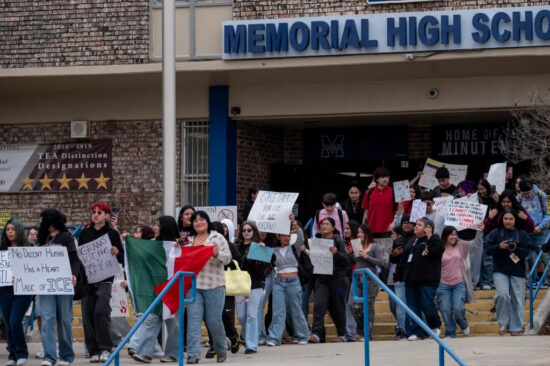
via the Texas Tribune

Entering the United States without immigrating properly is not an accident; it is a choice made by adults. When a student is deported midway through their education, that disruption is not the result of some sudden moral failure by the state, but the delayed consequence of decisions made years earlier by guardians who assumed the risk and proceeded anyway.

Every undocumented family understands, at least implicitly, that their status is provisional and contingent. Access to public schooling does not convert an unlawful entry into a permanent guarantee of residence. Parents chose a path that exposed their children to instability. That does not make the children culpable, but it does make the adults responsible. Converting that parental failure into a moral indictment of enforcement institutions, and then using students as emotional leverage against those institutions, does not correct the original decision.

Staging Student Dissent

Recent K–12 walkouts illustrate exactly how student protests function as adult-mediated spectacle rather than independent civic judgment. In Texas, the Houston Chronicle documented Fort Bend ISD students leaving class mid-morning to gather on football fields and parking lots, chanting familiar activist slogans such as the classic “no human is illegal on stolen land,” and framing immigration as a moral absolute rather than a policy question. Similar scenes followed across the Houston area, with planned walkouts coordinated via social media and hundreds of students protesting ICE after a single detention case was elevated into a district-wide symbol.

In Utah, middle- and high-school students walking off campus, carrying Mexican flags alongside American ones, and displaying signs reading “ICE is better crushed,” rhetoric that clearly exceeds neutral civic education and reflects adult ideological messaging. In Oregon, Portland high school students marching through city streets during school hours chanting “This is what democracy looks like!” and “Stop ICE Terror Now,” again mirroring standardized activist language. Across these cases, the pattern is consistent: minors leaving compulsory classrooms to repeat movement slogans, framed as brave moral action, while the optics of youthful defiance are leveraged to evoke sympathy, suppress dissent, and launder partisan positions through the perceived innocence of children.

via the LA Times

Marxist and quasi-Marxist movements have consistently targeted children and adolescents precisely because they are developmentally primed for moral absolutism, symbolic action, and group identity over institutional analysis. From early Soviet youth leagues to Komsomol, from Mao’s mobilization of students during the Cultural Revolution to the Red Guards, the logic has remained unchanged: bypass adult skepticism by moralizing politics through youth, then weaponize their visibility and perceived innocence to generate pressure and legitimacy.

What we are seeing in contemporary K–12 walkouts is not a spontaneous civic awakening but a softened, domesticated version of the same tactic. The rhetoric is simplified, consequences are abstracted, and participation is framed as virtue rather than understanding. The fact that these demonstrations occur inside taxpayer-funded schools, under the implicit authority of educators.

When compulsory public schools become venues for partisan mobilization, students are no longer being educated, they are being positioned. Their age, visibility, and lack of agency are exploited to manufacture moral urgency, obscure accountability, and pressure the public through emotional blackmail rather than argument. A system that claims to protect minors while repeatedly placing them at the center of ideological conflict is not acting in their interest. It is using them. And that is the ethical failure at the core of these protests, not disagreement over policy, but the quiet normalization of political instrumentalization in spaces where neutrality was once assumed.

References

Natalie Portman’s Tears are as Fake as Kathy Griffin’s Hairpiece

This week we were treated to another round of political theater, with Natalie Portman, that gay drug dealer from Breaking Bad, and Kathy Griffin calling for a color revolution against the ‘fascist’ Donald Trump Regime… But lets be real, If shit actually hit the fan, you won’t catch Kathy anywhere near the front lines. There is no way on earth she is going to be the one eating a beanbag round or catching a tear gas canister on live television.

Image via E! News

Unlike these fake celebrities out here crying on cue, there will be no sympathy for Alex Pretti found on this shit hole of a website. Federal agents, medical professionals, ICE—these are all part of the same enforcement apparatus. Pretti wasn’t an outsider challenging power; he was an ICU nurse embedded in the very system he claimed to oppose. He should have gone to work instead of playing revolution. This wasn’t martyrdom or resistance, but delusion followed by predictable consequences.

The Fate of the Useful Idiot

“The useful idiots, the leftists who are idealistically believing in socialism or communism, will be the first to be lined up against the wall and shot. They will not be needed anymore. They know too much. They are idealists. They will be eliminated.”

“They are used only for destabilization. Once the job is done and power is consolidated, they become a burden. They are not trusted, and they are not rewarded.”

Yuri Bezmenov. Interview and lectures on ideological subversion , 1983–1985. Public lectures and televised interviews, United States.

Alex Pretti, and Renee Good are both prime examples of “Useful Idiots”. The fate of the useful idiot throughout history has always been unpleasant. The useful idiot is tolerated only so long as they are useful, and discarded the moment they become inconvenient. Bolsheviks turned on their own allies after the Russian Revolution, Mao’s Cultural Revolution consumed many of its young activists, and Castro’s Cuba imprisoned sympathetic intellectuals who had promoted the revolution abroad.

Political movements do not reward sincerity, and once their objectives are achieved, the state offers neither reward nor mercy to those who served them. The useful idiot is not remembered; what remains is a corpse reduced to a number in a forgotten ledger.

Image via NPR

The Horse at the Gate

Systems do not need crises to expand control, only pretexts. This week, Artificial Intelligence finds itself on the chopping block. Deliberate misuse (specifically the generation of sexually explicit material involving children) has provided regulators with the perfect moral justification to restrict AI more broadly to the general population. The language used is always protective and framed as harm reduction, but the objective is to limit access to a tool capable of rapidly acquiring and synthesizing information in ways that could destabilize institutional authority or cultivate public mistrust.

This tactic is not new. It is the same mechanism used for over two decades to censor or regulate the internet. Invoke children. Invoke safety. Invoke extremism. The public response becomes automatic and dissent is reframed as an endorsement of harm. Regulation advances not because it is coherent or technically sound (in fact, most legislators have repeatedly demonstrated their inability to understand the systems they seek to regulate) but because it is emotionally insulated from criticism. The result is a population increasingly reliant on filtered, delayed, and sanctioned access to information, reassured that these limitations exist for their own protection, and for the protection of their children.

And Thus, a Lemon Party

At the same time, political activism continues its drift from opposition into performance. Over the weekend, anti-ICE activists, along with Don Lemon, stormed a church service, disrupting worship and accusing one of the pastors of being an ICE official or some shit. The choice of target was not accidental. Churches are safe targets: culturally disarmed, institutionally apologetic, and unlikely to respond with force. The same action directed at a mosque, or a synagogue, would not have occurred because of the potential for real consequences.

Image via Baptist Press

This asymmetry is never acknowledged. Instead, the legacy media frame remains intact: ICE is portrayed as a gestapo-like entity, while illegal immigrants are described as functionally indistinguishable from legal US citizens in rights and moral standing. Nuance is abandoned in favor of a childlike narrative structure. Politics is flattened into good versus evil and disagreement becomes immorality, and the enforcement of the existing law is being reframed as human cruelty in the mainstream media to advance a narrative. This narrative serves a material purpose. The continued influx of cheap, disposable labor benefits political and corporate interests at the direct expense of domestic workers. The irony is difficult to miss: the politicians most vocal about “human rights” are often those who stand to gain the most from the presence of this labor. So much for resisting corporate power.

Image via Fox News

The most revealing aspect is that none of this behavior carries risk. No meaningful legal consequences follow. The activists will not be charged. They will not be condemned by institutions that matter. In fact, they are often indirectly funded, protected, or amplified by the same corporate and philanthropic structures they claim to oppose. When billionaires, multinational institutions, and entire governing blocs align with your “revolution,” the term stops meaning anything.

Image via X.com

There is nothing revolutionary about terrorizing Christians, a religion that has spent decades defanging itself, apologizing for its own existence, and materially supporting the very systems that undermine it. There is nothing radical about enforcing consensus on behalf of the system while pretending to resist it. What we are watching is not rebellion, but managed dissent—safe, predictable, and ultimately useful to the system it claims to challenge.