
Unless you’re a boomer, or been offline for the past decade, you’ve probably heard of Eugenia Cooney. After years in the public eye and a highly publicized 5150 hold forced on her by online peers, her condition has (unsurprisingly) continued to deteriorate. Whatever the intent behind that intervention, the outcome is obvious: she is now visibly at her lowest weight to date.
The cold, harsh truth is that you can lead a horse to water, or in this case a dinner plate, but you can’t make it eat. Cooney has shown no real interest in recovery, so this article isn’t going to pretend otherwise. There’s no sugarcoating what prolonged anorexia does to the body, especially when it’s openly maintained as a lifestyle.

What follows is an examination of the stranger, less discussed physical effects of extreme anorexia, using one of the internet’s most recognizable “RawrXD skeletons” as a real-world reference. This project began as a series of Reddit posts, but after repeated removals by moderators, it became clear the material was better suited to a platform not subject to parasocial gatekeeping or performative hand-wringing about “empathy.” Eugenia Cooney has chosen to exist as a public figure whose entire online presence revolves around her disorder. Discussing the visible consequences of that choice isn’t immoral. It’s a direct response to what has been publicly displayed, documented, and monetized.
So, What Does She Eat?
No one knows Eugenia Cooney’s exact weight. For the sake of analysis, I used a conservative estimate based on a height of approximately 5’5″ (most sources place her somewhere between 5’4″ and 5’7″) and a BMI of 14, which corresponds to roughly 86 pounds. From there, I ran the numbers and compared them against what is physiologically plausible. These figures aren’t presented as fact, they’re reference points used to contextualize the visible effects discussed here.
Estimated range:
- BMR: ~830–1,110 kcal/day
- TDEE (very low activity): ~1,000–1,400 kcal/day
To the average American, that range sounds impossible. It isn’t. Not in the short term, and especially not in a body that has been metabolically adapted through long-term restriction. That’s the part people consistently misunderstand. This isn’t acute starvation. It’s sustained, disciplined maintenance at an extremely low baseline.
Despite popular myths, Eugenia Cooney does not “eat nothing” or filter feed like a sea sponge. She almost certainly eats every day. What explains the appearance isn’t magic or superhuman willpower. It’s consistency. Low intake, low variation, and years of metabolic suppression. This is where dieting ends and pathology begins, where control becomes the behavior itself rather than a means to an end.
The Anatomy Behind Eugenia’s Hidden “Tail”
One of the more visually striking effects of extreme anorexia is the so-called “tail.” This isn’t a mutation or some bizarre anomaly. It’s basic anatomy.

Severe muscle wasting affects the gluteal muscles, lower back, and core (structures that normally stabilize the pelvis and cushion the spine). As these tissues atrophy, the underlying skeletal landmarks become visible. Fat loss around the hips further exaggerates this effect, and the pelvis can rotate slightly as muscular support collapses.
Under normal conditions, the coccyx is padded and invisible. When that padding disappears, the bone can protrude sharply, especially when sitting or bending. What people interpret as a “tail” is simply exposed skeletal structure combined with postural distortion from prolonged malnutrition.
Raw Contact with Reality via Bootyhole
There’s also the unspoken physics problem nobody wants to acknowledge. At a certain point, there’s just… nothing left back there. No padding. No buffer. No suspension system. Every chair becomes a medieval torture device. Benches, plastic seats, theme park rides, all suddenly qualify as hostile terrain.
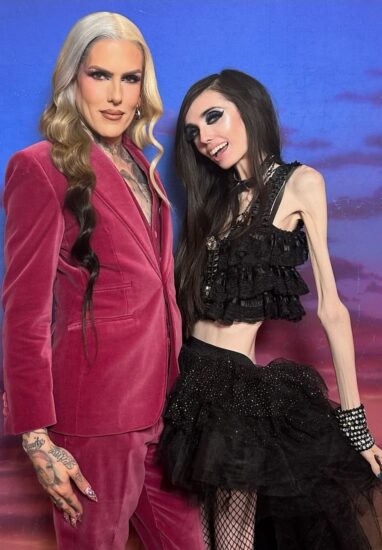
Which raises a legitimate question: how does Eugenia Cooney even tolerate places like Disneyland? Those rides are already engineered for maximum bacterial density, and now you’ve got direct butthole-to-surface contact like some kind of human petrie dish. It’s not body-shaming, it’s ergonomics. The human body is not designed to raw-dog public seating. Remove the fat, remove the cushion, and suddenly sitting down becomes an endurance sport and you’re just one fiberglass bench away from an infection and a very bad day.
“Girls Don’t Poop”
We’ve all heard the phrase “girls don’t poop” at some point in our lives, which is obviously untrue… unless you’re Eugenia Cooney. In cases of extreme anorexia, digestion doesn’t disappear, but it slows to such a degree that the joke starts sounding uncomfortably literal.
At sustained low intake, the gastrointestinal system enters conservation mode along with the rest of the body. Food volume drops, fiber intake vanishes, and fat consumption becomes negligible. The muscles responsible for moving waste through the intestines weaken. Peristalsis slows. Transit time stretches. What little material enters the system can take days to exit, if it does at all.

It’s simple mechanics. There’s barely anything moving through the system, and what little there is can take days to pass… if it passes at all. Like everything else in this condition, it looks surreal from the outside but is brutally logical once you understand the physiology. Less input. Less output. Fewer signals. Reduced function.
None of this is meant to shock for the sake of spectacle. When the body is pushed into prolonged restriction, it adapts in ways that are strange. What looks uncanny from the outside is, in reality, just biology following rules it can’t opt out of. Eugenia Cooney’s visibility makes these effects harder to ignore, but they are not unique to her. They are the predictable result of a system under chronic deprivation—quiet, mechanical, and deeply unglamorous.